Old Oak Damascus EDC

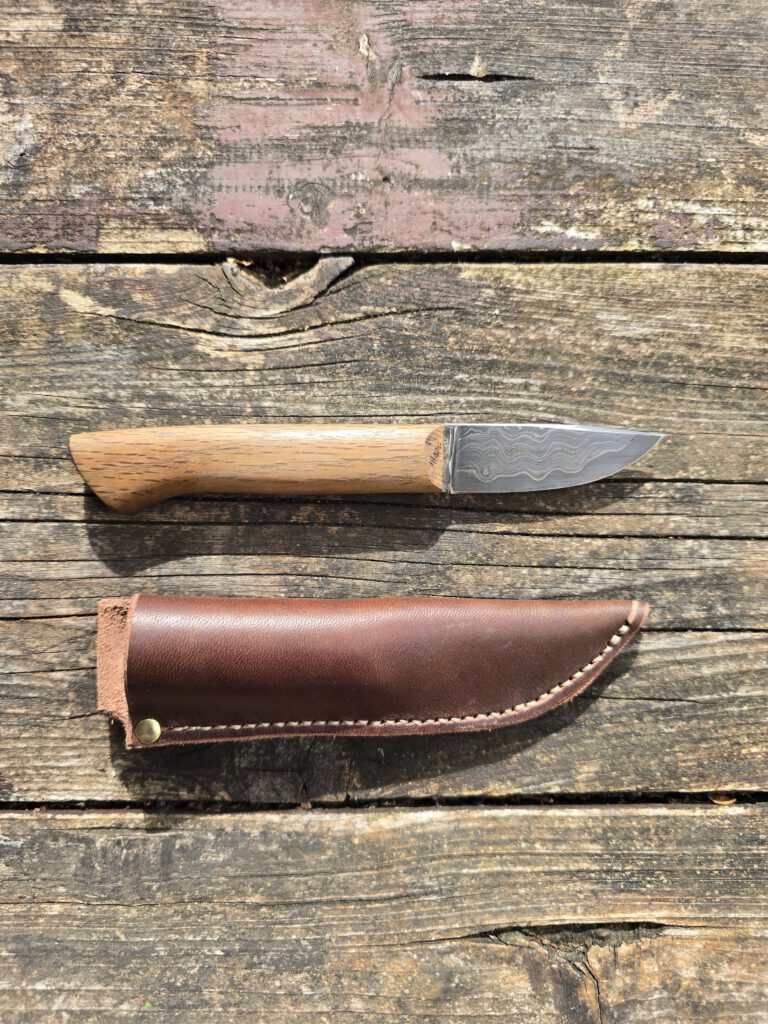
This is a small, straightforward EDC with a lot of character packed into very little knife. The 7 cm blade is compact enough for everyday carry, but the full flat grind and thin edge geometry make it especially good for controlled carving and small utility work.

I forged the blade from K720 and chainsaw-chain Damascus. The spine is a substantial 4 mm thick, which gives the knife some strength and presence, while the edge itself is ground much finer than the thickness would suggest.

The handle is made from old oak taken from a beam I found in a ruined building here in Umbria. That history is one of the reasons I kept the rest of the knife simple. The wood already brings enough character on its own.

The sheath is a plain hand-stitched leather pouch sheath. No decoration, no unnecessary details — just a compact knife, a simple sheath and materials that have their own story.

Knife type: EDC / carving knife

Overall length: 18 cm

Blade length: 7 cm

Blade height: 2.2 cm

Blade thickness: 4 mm

Handle length: 11 cm

Steel: K720 with chainsaw-chain Damascus
Hardness: approx. 60–61 HRC

Construction: Hidden tang

Grind: Full Flat Grind

Handle: Old oak from a reclaimed Umbrian beam
San-Mai Petty Sujihiki

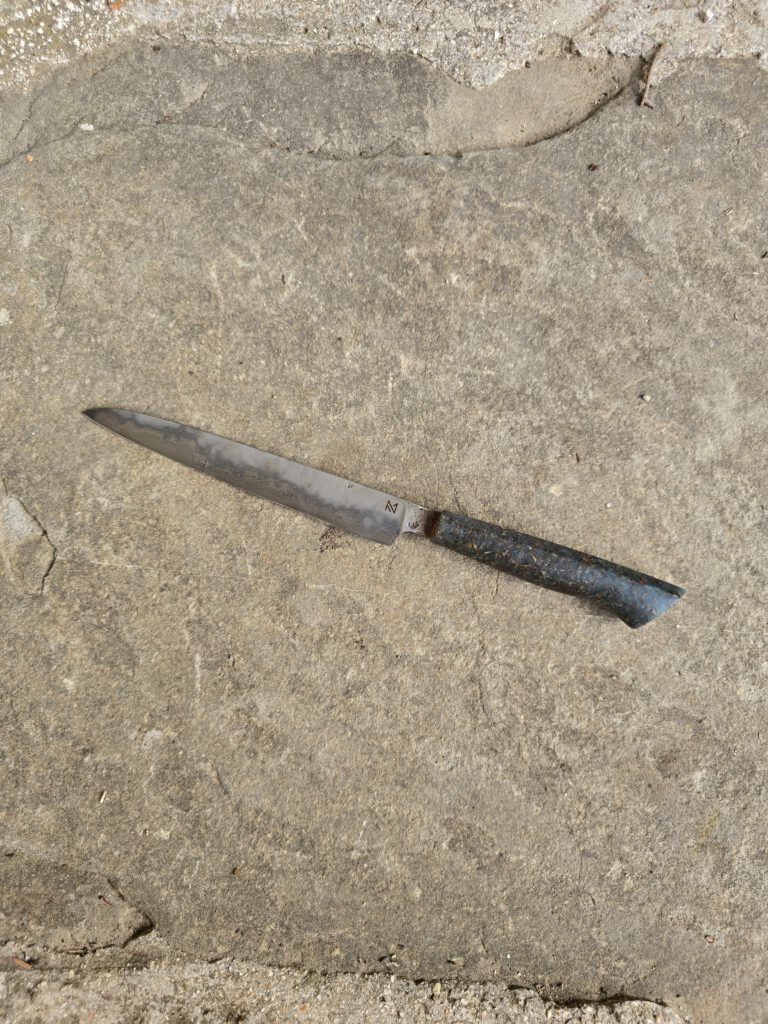
This Petty Sujihiki sits somewhere between a long petty and a compact slicer. The narrow blade and long distal taper make it feel light and precise, while the very thin geometry helps it move cleanly through food with very little resistance.

I forged the blade as San-mai, using a spring steel core with mild steel cladding. The spine is around 2.5 mm at its thickest point and tapers continuously toward the tip. Combined with the full flat grind, this gives the knife a noticeably fine and flexible character.

The handle is one of my favourite shapes to make. The upper side keeps a more angular, Japanese-inspired geometry, while the underside is rounded and flowing for a more comfortable grip during longer cutting work. I made the handle material myself from epoxy resin, pigment powder and fine wood dust. It is very forgiving in everyday use and has an appearance that almost resembles stone.

I would use this knife mainly for boneless meat, fish and other precise slicing work where a narrow blade and clean draw cut are more useful than the height and weight of a larger chef’s knife.

Overall length: 29 cm

Blade length: 18 cm

Cutting edge: 16.5 cm

Blade height: 2.4 cm

Blade thickness: max. 2.5 mm

Handle length: 11 cm

Steel: San-mai, spring steel core with mild steel cladding

Hardness: approx. 60 HRC

Construction: Hidden tang

Grind: Full Flat Grind

Handle: Handmade epoxy composite with pigment powder and wood chips

San-Mai Nakiri / Olive Handle

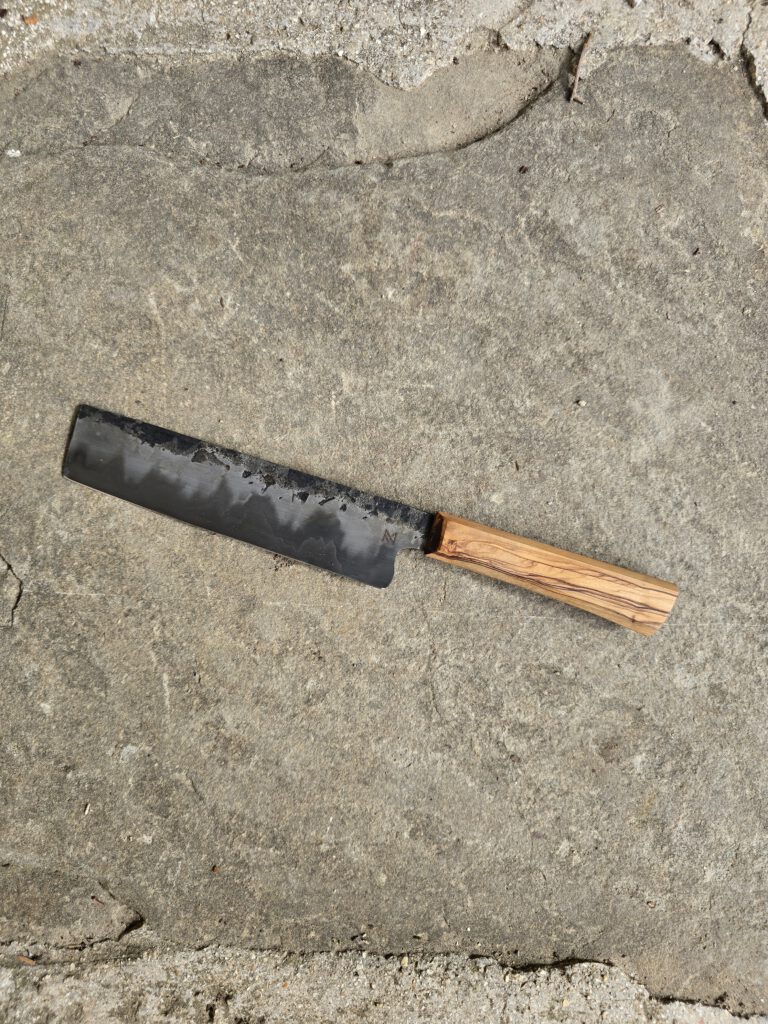
This Nakiri is made for vegetables and precise board work. At 18.5 cm it offers plenty of usable edge, while the 4.3 cm blade keeps it a little slimmer and more agile than many traditional Nakiri.

The blade is forged as San-mai, with a C70 carbon steel core at around 60–61 HRC and mild steel cladding. Despite the substantial 3 mm spine, it is ground very thin behind the edge, giving it a solid feel in the hand while still cutting cleanly and efficiently.

I deliberately left part of the original forge scale on the upper section of the blade. Together with the etched hand finish, it keeps the forged character visible instead of polishing every trace of the process away. The blade is protected with carnauba wax.

The handle is made from olive wood in a traditional Japanese octagonal form.

I would mainly use this knife for vegetables, herbs and general board work. The thin edge is made for clean cutting, not for bones, frozen food or twisting through hard material.

Specifications

Knife type: Nakiri

Blade length: 18.5 cm

Blade height: 4.3 cm

Blade thickness: 3 mm

Handle length: 11.5 cm

Steel: San-mai — C70 core with mild steel cladding

Hardness: approx. 60–61 HRC

Handle: Olive wood

Grind: High Flat Grind

Finish: Etched hand finish with retained forge scale

Scroll to Top